I have moved over to WordPress.
Please visit me at 100milewear.com to see my latest blog post about "How to avoid SSS - Second-Sock-Syndrome."
See you over there!
Thursday, December 18, 2014


Sunday, November 30, 2014
Sad story about the cotton crop
I attended a workshop in October 2013 about spinning cotton - on your wheels. It was great fun and I came away with a new passion and respect for cotton as a fibre. We were each given a couple of seeds of Heritage Bush Cotton in our workshop kits. I got a few more seeds from other participants for a total of 6 seeds. I planted then on May 20th and 5 came up.

They grew nicely and in a short while I transplanted them to a sunny hot corner of the garden.

They grew slowly and steadily -- reaching about 24 - 30 inches in height.

And then the magic happened. This thing that looks like a folded over leaf is actually the beginning of the blossom.

See, when I gently fold back the greenery, inside is the beginning of a blossom.


A few weeks ago we had Arctic outflow winds for several days. In fear that the cotton plants wouldn't survive the sub-zeros nights and the windchill, I dug them up and brought them in the house. Where they promptly died or went into dramatic dormancy - I am eternally optimistic.
I can't show photos of that as it is far too upsetting. We'll see what happens in the spring if they come back. In the meantime, I'm getting more seeds and I'll plant them in February so they are well on their way by the time the summer heat comes. They really needed another couple of months, I'll keep trying.
Two new half-mitt patterns
I finally finished writing up the patterns for these half-mitts and finalizing the feedback from the test knitting. There are two of them and they are available for free on Ravelry.
They are first cousins, having a lot of similarity. They have the same thumb gusset, the same 3 x 1 rib set up and coin lace. There are tiny differences which make for slightly different looks, but they are equally difficult/easy.
This one is called Coin Lace Half-Mitt. The coin lace pattern happens every seventh round which makes it look at bit like a cable pattern. It also has a slightly different treatment at the cuff when you get started. Here's the link: Coin Lace Half-Mitt
 .
.
This one is called Sitka Spruce Half Mitts - named after the colourway by Sweet Georgia Yarns. The coin lace pattern for this one happens every fifth round making the coin lace look rounder, more like a coin. This pattern also comes with a chart, so if you are new to knitting half-mitts with a pattern and thumb gusset, the chart with help you find your way. Here's the link for this one Sitka Spruce Half Mitts.

They are so easy to make and only take a 50g skein of fingering or DK yarn. You can easily make several in a week. Thanks to Tina for the test knitting and for all these lovely samples.

I have another pattern under development. So let me know what you think of these and the way I explain things. Happy knitting!
They are first cousins, having a lot of similarity. They have the same thumb gusset, the same 3 x 1 rib set up and coin lace. There are tiny differences which make for slightly different looks, but they are equally difficult/easy.
This one is called Coin Lace Half-Mitt. The coin lace pattern happens every seventh round which makes it look at bit like a cable pattern. It also has a slightly different treatment at the cuff when you get started. Here's the link: Coin Lace Half-Mitt
.This one is called Sitka Spruce Half Mitts - named after the colourway by Sweet Georgia Yarns. The coin lace pattern for this one happens every fifth round making the coin lace look rounder, more like a coin. This pattern also comes with a chart, so if you are new to knitting half-mitts with a pattern and thumb gusset, the chart with help you find your way. Here's the link for this one Sitka Spruce Half Mitts.
They are so easy to make and only take a 50g skein of fingering or DK yarn. You can easily make several in a week. Thanks to Tina for the test knitting and for all these lovely samples.
I have another pattern under development. So let me know what you think of these and the way I explain things. Happy knitting!
Friday, November 21, 2014
A Fibre & Colour Challenge
At the Langley Weavers and Spinners Guild Annual Artisan Sale I sold my Candygram socks to a fellow artisan. Similarly inspired by the colours in the socks she bought, she asked me if I ever worked on commission.
My answer, "It depends. What are you looking for? Tell me more."
So she showed me this photo of Turkey Tail Fungus that caught her attention.
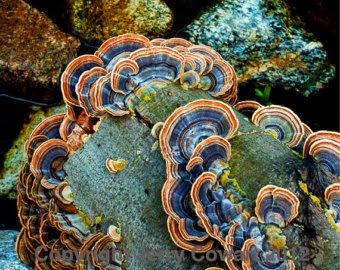
It's pretty amazing stuff in terms of colors and shapes. So I agreed to try to recreate this look and feel into a pair of socks. Crazy challenge in some ways, but so weird and wonderful why not try?
I have a few strategies at hand.
Plan A: easiest one is to over dye a pair a pair of socks that I have on hand. They are pink, orange and yellow - with an over dye of indigo they may just give me the look I'm after.
Plan B: spin a braid of Sweet Georgia Yarns "Bourbon" but add some burgundy and white bits. Lots of work to spin, ply and knit. But will certainly do the trick.
Plan C: . . . hasn't been thought through yet. That will involve space dyeing a skein of sock yarn that will do wonderful striping. But that's Plan C. And we hardly ever get to Plan C right?
But then as I write this and think it through, there is also the wonderful curly element that needs to be considered. I must hit the pattern books to find the right way to describe this. I may even need a Plan D for this project.
Thanks Dawn for the challenge!
My answer, "It depends. What are you looking for? Tell me more."
So she showed me this photo of Turkey Tail Fungus that caught her attention.
It's pretty amazing stuff in terms of colors and shapes. So I agreed to try to recreate this look and feel into a pair of socks. Crazy challenge in some ways, but so weird and wonderful why not try?
I have a few strategies at hand.
Plan A: easiest one is to over dye a pair a pair of socks that I have on hand. They are pink, orange and yellow - with an over dye of indigo they may just give me the look I'm after.
Plan B: spin a braid of Sweet Georgia Yarns "Bourbon" but add some burgundy and white bits. Lots of work to spin, ply and knit. But will certainly do the trick.
Plan C: . . . hasn't been thought through yet. That will involve space dyeing a skein of sock yarn that will do wonderful striping. But that's Plan C. And we hardly ever get to Plan C right?
But then as I write this and think it through, there is also the wonderful curly element that needs to be considered. I must hit the pattern books to find the right way to describe this. I may even need a Plan D for this project.
Thanks Dawn for the challenge!
Sunday, November 2, 2014
Steampunk Spindles - a new treat
My spindle maker has recently revived an old passion - music. As a result he is making fewer, and fewer spindles. Every time I offer a spindling workshop I cross my fingers that he will agree to make the 8 - 12 spindles that I order. So far he has not let me down. But I also want to respect that his passion for this is waning and don't' want him to be obliged. Thus I am hunting for a new spindle maker.
The spindles that I use in my workshops are a large part of the reason why participants leave after 3 - 4 hours spinning successfully. The spindles are perfectly balanced, have a hook that is always easy to find, a notch right across from the hook, and a tapered shaft that gives the spindler a couple of gears.
So this is a hard act to follow.
The other night I started my search by cruising on Etsy. I could never have imagined how many spindles there are on Etsy. But there they all were. I cruised around, clicked, read, clicked again and then came across the Steampunk Spindle by SnyderSpindles. I had seen it earlier in the year when he just developed them. I love the look of them and from the reviews, I figured they were worth a piece of my R & D budget. So I ordered one. Then I saw that they were two different weights, so I ordered one in each weight. It didn't impact the shipping charge much from just one spindle. And then I saw one that was done in a green-ish stain, so I ordered that one too.
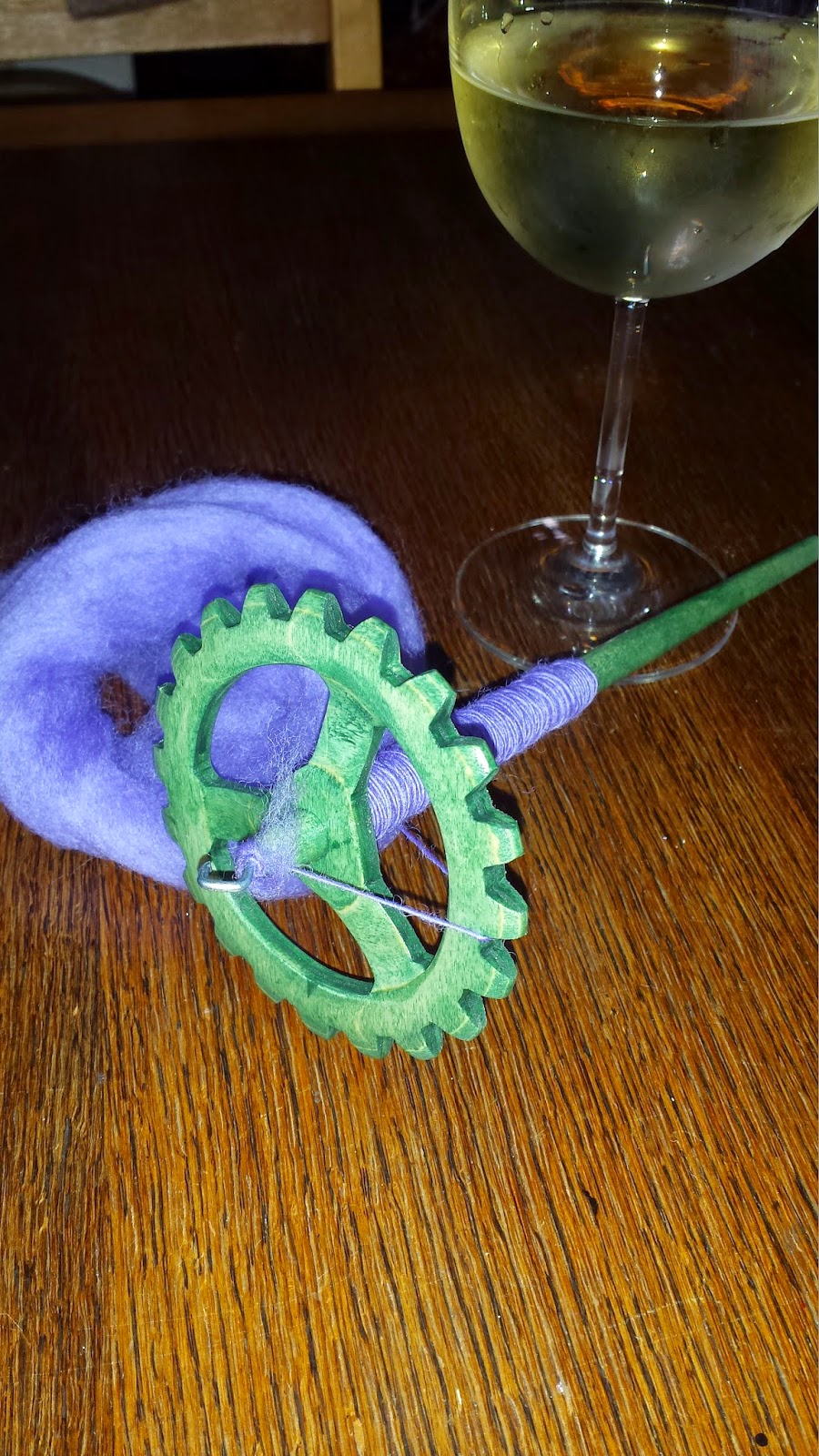
I now have three Steampunk Spindles, two light-weight and one medium weight. I'm spending my spinning time this weekend test driving/spinning them. So far, I like their action. I especially like their look with the funky gear cut outs on the rim that actually have a function as over a dozen notches. The ultimate test is how they behave as they get more and more fibre on them. Will let you know.

I haven't given up on my spindle guy. I love the fact that he is local. But in the event that he is moving on, I need to find a good alternative. And besides, the research is fun!
The spindles that I use in my workshops are a large part of the reason why participants leave after 3 - 4 hours spinning successfully. The spindles are perfectly balanced, have a hook that is always easy to find, a notch right across from the hook, and a tapered shaft that gives the spindler a couple of gears.
So this is a hard act to follow.
The other night I started my search by cruising on Etsy. I could never have imagined how many spindles there are on Etsy. But there they all were. I cruised around, clicked, read, clicked again and then came across the Steampunk Spindle by SnyderSpindles. I had seen it earlier in the year when he just developed them. I love the look of them and from the reviews, I figured they were worth a piece of my R & D budget. So I ordered one. Then I saw that they were two different weights, so I ordered one in each weight. It didn't impact the shipping charge much from just one spindle. And then I saw one that was done in a green-ish stain, so I ordered that one too.
I haven't given up on my spindle guy. I love the fact that he is local. But in the event that he is moving on, I need to find a good alternative. And besides, the research is fun!
Washing Merino - from filthy to fine
Merino is by far one of the loveliest fibres to work with. It is fine, soft and has a consistent crimp that gives it some bounce. It is also prone to felting - some may think this is a good thing, but it is a caution when you buy raw wool and need to wash it.
Here's a wee tutorial about how to wash Merino. First you separate it into finger width locks and stack them in a tray. Please note: the yellow bar is NOT BUTTER, it is a bar of Sunlight soap.
Cover your work area with a good towel. Fill three bowls/buckets halfway with the hottest tap water you have, then fill them the rest of the way with boiling water. Yes, boiling water. The heat is what is going to melt the lanolin from the locks.
Look at how dirty these locks are. You won't believe how clean they will turn out. Just watch.

Here's how you do it. You grab the first lock by the tip end (that's the pointy and dirtiest end) and dip the butt end half into the hot water of bucket one. Then place the lock over the Sunlight soap and rub it up really good, add a bit of water to help get the suds action. It won't felt at this stage because the soap is in the way. Then grab the soapy butt end of the lock and dip the tip end into the hot water of bucket one. Place this half on the soap and again rub up a storm to get the dirt and lanolin out.

Then grab one end and dip it into bucket two, swirling it gently to rinse it. Lift it out gently and turn it around and dip the other end into bucket two. That's the first rinse.
Do the same thing in bucket three, dipping both ends, one at a time, into the rinse water. Then take the lock, gently place it on a towel, fold an end of the towel over the lock and gently press the water out. Lay it on a tray to dry. It will look like a flattened mouse, but in a short while, as it dries, it puffs up.

You can do about 10 locks at a time before the water gets too cool and too dirty to have an effect. So pace yourself. It may seem outrageously laborious, but Merino is so fine, a little bit of cleaned fibre goes a very long way.
And here below I am getting ready to spin. More later on tips for spinning Merino.

Here's a wee tutorial about how to wash Merino. First you separate it into finger width locks and stack them in a tray. Please note: the yellow bar is NOT BUTTER, it is a bar of Sunlight soap.
Cover your work area with a good towel. Fill three bowls/buckets halfway with the hottest tap water you have, then fill them the rest of the way with boiling water. Yes, boiling water. The heat is what is going to melt the lanolin from the locks.
Look at how dirty these locks are. You won't believe how clean they will turn out. Just watch.
Here's how you do it. You grab the first lock by the tip end (that's the pointy and dirtiest end) and dip the butt end half into the hot water of bucket one. Then place the lock over the Sunlight soap and rub it up really good, add a bit of water to help get the suds action. It won't felt at this stage because the soap is in the way. Then grab the soapy butt end of the lock and dip the tip end into the hot water of bucket one. Place this half on the soap and again rub up a storm to get the dirt and lanolin out.
Then grab one end and dip it into bucket two, swirling it gently to rinse it. Lift it out gently and turn it around and dip the other end into bucket two. That's the first rinse.
Do the same thing in bucket three, dipping both ends, one at a time, into the rinse water. Then take the lock, gently place it on a towel, fold an end of the towel over the lock and gently press the water out. Lay it on a tray to dry. It will look like a flattened mouse, but in a short while, as it dries, it puffs up.
You can do about 10 locks at a time before the water gets too cool and too dirty to have an effect. So pace yourself. It may seem outrageously laborious, but Merino is so fine, a little bit of cleaned fibre goes a very long way.
And here below I am getting ready to spin. More later on tips for spinning Merino.
Tuesday, October 14, 2014
Spinzilla 2014 - Final Tally
Here is the final tally. 10 skeins - #10 is a wee 41 yard skein of organic cotton singles. The final measure is 6,576 yards - 830 grams.
There are many things I would do differently - and thus be able to spin faster and more efficiently. But that's for a later blog post and my own reflections for next year.

Subscribe to:
Posts (Atom)